
How your company can boost efficiency with AI
May 18, 2026 | 5 minute read
Key takeaways
- Businesses can get real-time access to information about their finances, customers and competitors by using AI tools.
- Business owners and executives need to identify the specific pain points that the tool is intended to solve before adopting AI as a solution.
- The areas where business owners are getting the most value from AI are cash flow management, customer acquisition and servicing, and back office operations.
Many business owners are working more hours because of staff shortages while also worrying about inflation, interest rates and tariffs. Yet, according to Bank of America’s 2025 Business Owner Report, 91% of those polled plan to utilize digital tools in the next five years. Many are turning to artificial intelligence (AI) and digital tools, with 77% of business owners reporting they have already integrated AI into their operations over the past five years.
Elizabeth Urbanski, head of business banking product and digital experience at Bank of America, sees AI as a partner. “AI is an opportunity to help save time and to be more efficient in the roles that we have,” she says. “It allows us more time to be able to focus on some of the other key parts of our jobs.”
The case for deploying AI and digital tools is clear, but implementing a program may seem daunting to newcomers. Here’s how your business can get started with AI.
Identify your biggest pain points
When adopting new technology, one of the most common traps is focusing on the tool rather than the problem it can solve. Instead, start by examining your workflow. Track daily activities — especially those that are repetitive and data-heavy — and calculate the cost of doing those tasks manually versus automating them. This exercise can reveal some surprising insights about how you and your employees spend time.
To get the biggest bang for your buck, consider these three common pain points where business owners are getting the most value from AI and digital tools:
1. A real-time view of cash flow
For many business owners, financial visibility feels like looking in the rearview mirror. Without an up-to-date view of financial data, businesses may be making critical decisions on outdated or incomplete information. Common problems include not knowing your exact cash position, delayed payment tracking and hours spent manually reconciling books.
Digital banking tools and AI-powered virtual assistants are changing how businesses monitor finances. Rather than waiting for month-end reports, business owners can get real-time answers to questions like “What’s my current cash flow outlook?” These tools, such as the financial assistant Erica®, can alert business owners to upcoming payments, unusual receivables patterns or opportunities to optimize expenses before any problems escalate.
2. Marketing and customer acquisition
Half of business owners surveyed are already using AI for marketing. Generative AI tools can help develop blog topics, write social media posts, generate email newsletter templates and even develop product descriptions — all time-intensive tasks that may require a specialized skill set.
AI also helps businesses personalize at scale, a capability once available only to large corporations with dedicated marketing teams. Instead of sending the same email to your entire list, most marketing platforms use AI to segment customers and tailor messages based on past behavior, purchase history or engagement patterns. “Businesses should leverage the opportunity for hyper-personalization,” Urbanski says. “It’s not about replacing employees, but about using AI to assist them in reaching the right audiences at the right time.”
3. Customer service and administration
AI can be useful in automating repetitive and time-consuming tasks. Bank of America’s survey found that 39% of business owners are using AI to streamline administrative tasks, while 37% are deploying AI for customer service.
To start, gather your most common customer inquiries, questions like “What are your hours?” or “Do you offer delivery?” Simple questions like these can be handled by AI, allowing your team to focus on more complex customer needs. Similarly, instead of having your sales team screen every inbound lead, AI can assess them based on criteria you establish, freeing up time for high-value conversations. AI chatbots are a popular entry point, and many website platforms offer built-in chat capabilities that can handle routine inquiries 24/7, qualify leads, provide order status updates and schedule appointments.
For internal operations, AI can automate invoice generation, expense categorization and basic bookkeeping tasks. The tools can also transcribe and summarize meeting notes and simplify scheduling.
Start small and measure impact
When adopting new technology, begin with small steps. Choose one pain point first. If it’s cash flow, maybe start by connecting your banking and accounting tools. If marketing is taking up too much of your time, try AI for some content creation. Or if customer service is overwhelming you, add a chatbot to handle your most common questions.
Once you’ve implemented the solution, measure impact through time saved, return on investment gained, customer satisfaction or whatever metrics matter for that pain point. Give it at least a few months to see results. Evaluate and identify new opportunities. Then iterate, train your team and keep an eye on emerging tools.
Alongside these benefits, businesses must also manage new risks. While AI can turbocharge many aspects of your business, you also need to take steps to protect your data. You should never input confidential customer financial information, employee Social Security numbers, proprietary business formulas or other confidential data into AI tools. Be sure to train your team on what can be shared and what should remain private.
Getting started with AI prompts
Writing a prompt to get the best possible response from AI is as much an art as a science. Think of AI as a capable intern: Give it the background information, tell it exactly what you want it to do and add what you don’t want it to do.
Most prompts follow the same basic framework:
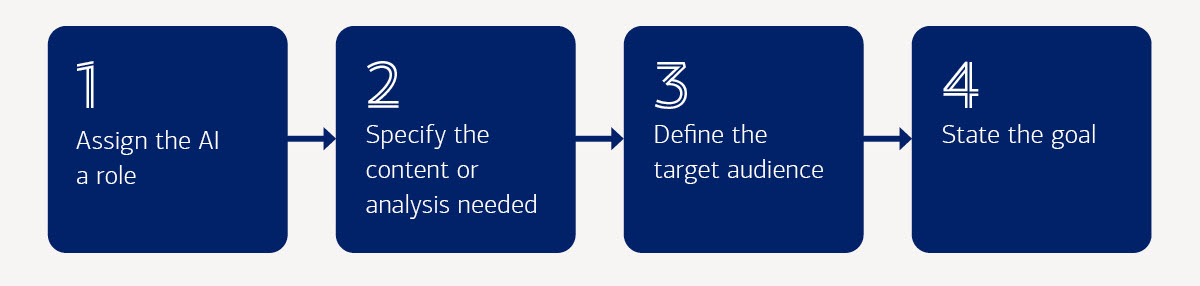
Here are a few examples of prompts specific to common pain points. Please note that these suggested prompts are provided as a guide. They should be adapted to your company’s specific needs and goals. To achieve the best results, prompt output must be reviewed, analyzed and validated by humans before they’re implemented.
Cash flow: You are acting as a chief financial officer for a small-to-medium-sized business. Review the attached financials: cash flow statement, income statement, balance sheet and accounts receivable/accounts payable. Provide a one-page cash flow snapshot with a clear explanation of the primary cash inflow drivers (e.g., collections, loan proceeds, seasonal revenue) and cash outflow drivers (e.g., payroll, inventory and debt repayment). Create a 12-week projected cash flow calendar using the inflow and outflow data. Write clearly without technical jargon.
Marketing: Act as a marketing strategist. Review the uploaded materials on the industry, the product and the target customer. Create a series of social media posts for Instagram, TikTok, X and LinkedIn that end with a call to action to visit our website. The tone should be optimized for the ideal end customer. Avoid corporate jargon and keep the language simple and direct.
Customer acquisition: You are a growth strategist for a small-to-medium-sized business assigned to create a practical, numbers-driven customer acquisition plan. Based on the information provided, identify weaknesses in the current acquisition approach, identify underused channels and highlight risks, such as too much concentration in one industry or channel. Provide a ranked list of optimal acquisition channels, such as paid search and paid social. For each channel, explain why it fits this business, the expected time for a result and the required budget.
Applications such as AI are just one more tool in the business owner’s toolkit. Connect with a Bank of America relationship manager to explore other tools that can help your business run and grow more efficiently.

Ready to meet with a specialist?
Our specialists are ready with advice and guidance to help move your business forward.
Important Disclosures and Information
Bank of America, Merrill, their affiliates and advisors do not provide legal, tax or accounting advice. Consult your own legal and/or tax advisors before making any financial decisions. Any informational materials provided are for your discussion or review purposes only. The content on the Center for Business Empowerment (including, without limitations, third party and any Bank of America content) is provided “as is” and carries no express or implied warranties, or promise or guaranty of success. Bank of America does not warrant or guarantee the accuracy, reliability, completeness, usefulness, non-infringement of intellectual property rights, or quality of any content, regardless of who originates that content, and disclaims the same to the extent allowable by law. All third party trademarks, service marks, trade names and logos referenced in this material are the property of their respective owners. Bank of America does not deliver and is not responsible for the products, services or performance of any third party.
Not all materials on the Center for Business Empowerment will be available in Spanish.
Certain links may direct you away from Bank of America to unaffiliated sites. Bank of America has not been involved in the preparation of the content supplied at unaffiliated sites and does not guarantee or assume any responsibility for their content. When you visit these sites, you are agreeing to all of their terms of use, including their privacy and security policies.
Credit cards, credit lines and loans are subject to credit approval and creditworthiness. Some restrictions may apply.
Merrill Lynch, Pierce, Fenner & Smith Incorporated (also referred to as “MLPF&S" or “Merrill") makes available certain investment products sponsored, managed, distributed or provided by companies that are affiliates of Bank of America Corporation (“BofA Corp."). MLPF&S is a registered broker-dealer, registered investment adviser, Member SIPC, and a wholly owned subsidiary of BofA Corp.
Banking products are provided by Bank of America, N.A., and affiliated banks, Members FDIC, and wholly owned subsidiaries of BofA Corp.
“Bank of America” and “BofA Securities” are the marketing names used by the Global Banking and Global Markets division of Bank of America Corporation. Lending, derivatives, other commercial banking activities, and trading in certain financial instruments are performed globally by banking affiliates of Bank of America Corporation, including Bank of America, N.A., Member FDIC. Trading in securities and financial instruments, and strategic advisory, and other investment banking activities, are performed globally by investment banking affiliates of Bank of America Corporation (“Investment Banking Affiliates”), including, in the United States, BofA Securities, Inc., which is a registered broker-dealer and Member of SIPC, and, in other jurisdictions, by locally registered entities. BofA Securities, Inc. is a registered futures commission merchant with the CFTC and a member of the NFA.
Investment products: